Why Your Business Shouldn't Use AI for Photos, Video, Graphics, or Flyers
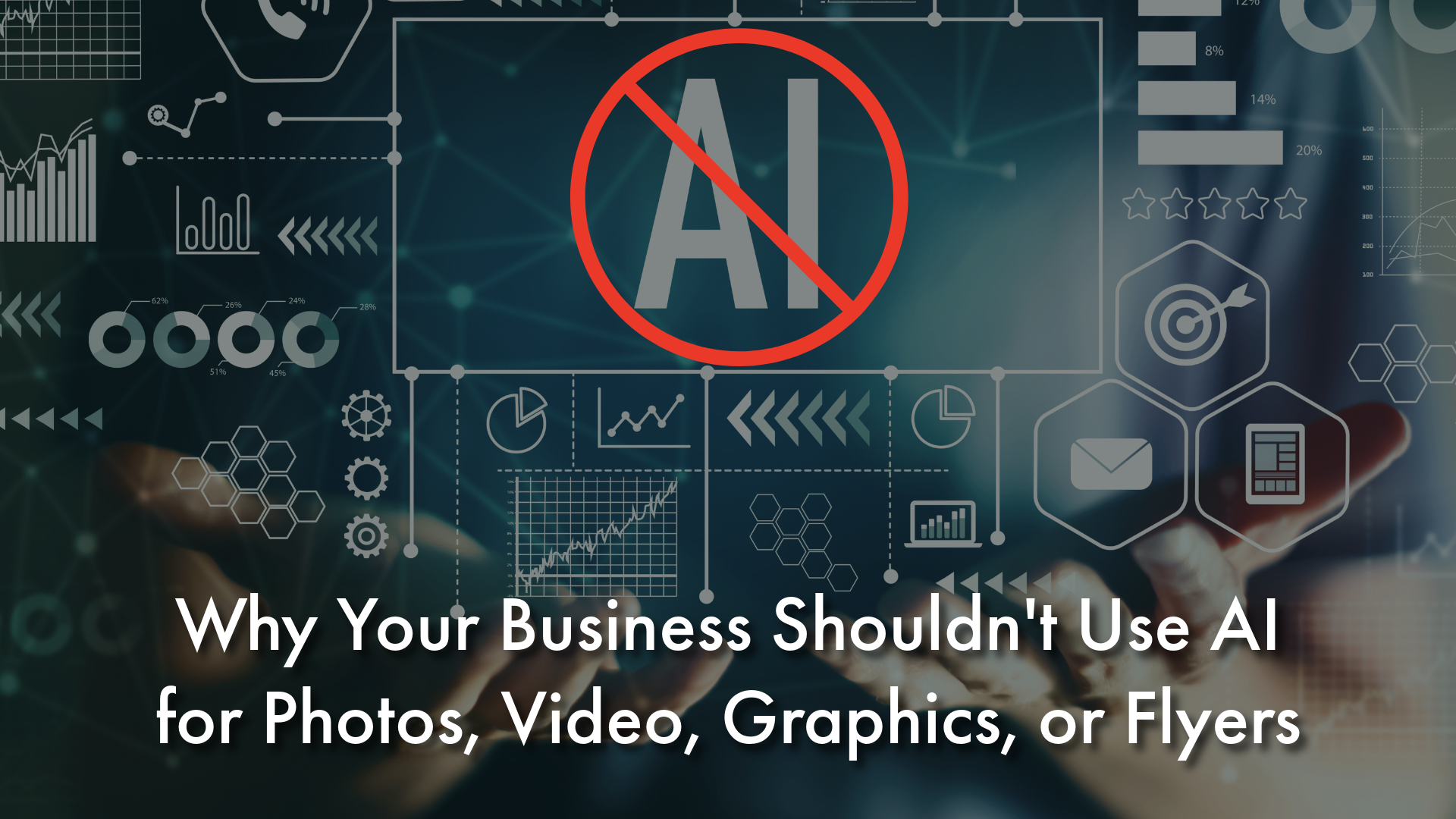
Why Your Business Shouldn't Use AI for Photos, Video, Graphics, or Flyers
There's a very good chance you've already been offered an AI shortcut for your business media. Maybe a vendor pitched it. Maybe someone on your team suggested it. Maybe you've tried it yourself and thought, that's pretty good for free.
Here's the thing: it might look fine at first glance. But "fine at first glance" is not a business strategy, and it's not a brand.
Here are three reasons AI-generated media is quietly working against your business, no matter what industry you're in.
1. Your Brand Looks Like Everyone Else's
AI image and video tools are trained on the same massive pools of data. That means the "professional" manufacturing floor photo, the "trustworthy" banker at a clean desk, the "modern" medical facility graphic, they all come from the same statistical average of every image that's ever existed on the internet.
The result? Your marketing looks like your competitor's. And their marketing looks like the company three states over.
That's the opposite of branding. Branding is the act of being recognizable, of having a look, a feel, a voice that people associate specifically with you. When a manufacturer in Columbia runs the same AI-generated imagery as a manufacturer in Ohio, neither one stands out to anyone. You've traded your identity for convenience.
Real brand photography shows your facility, your team, your process. It shows the things that are actually different about you, the custom machinery, the people who've been on the floor for 20 years, the certifications on the wall. AI can't generate those things. It can only generate a generic approximation of what a manufacturing company is supposed to look like.
The same goes for medical practices and financial institutions. Patients choose providers they trust. Customers choose banks they feel connected to. That connection doesn't come from stock-adjacent AI imagery. It comes from real faces, real environments, and real stories.
2. You Don't Own What AI Makes
This one surprises a lot of people.
Most AI-generated content, images, video, even graphics, exists in a legal gray zone when it comes to ownership. Depending on the platform and its terms of service, the content you "create" may not actually belong to you. Some platforms retain licensing rights. Others place generated content in the public domain, meaning anyone can use it, including your competitors.
More pressing: if someone copies or repurposes your AI-generated brand assets, you likely have no legal ground to stand on. You can't file a DMCA takedown for something you don't own.
There's also the flip side. AI tools are trained on existing copyrighted images, illustrations, and art. That means the image it generates for you might closely mirror protected work owned by someone else, and you're the one who published it. The ongoing legal battles between stock photo companies and AI generators aren't abstract industry news. They're directly relevant to any business putting AI-generated content on their website, in their ads, or in their marketing materials.
For a medical practice, that could mean a generated diagram that resembles a protected medical illustration. For a bank, a generated infographic that incorporates design elements from a competitor. For a manufacturer, product imagery that overlaps with a vendor's proprietary photography.
When you work with a professional production company and commission original media, you own it. Full stop. That's not a minor detail, it's the difference between a brand asset and a liability.
3. Inaccurate, Biased, and Unverifiable Content Hurts You
AI makes things up. That's not an opinion, it's a documented behavior called hallucination, and it affects generated text, data, and even imagery.
For businesses in regulated or high-trust industries, this is a serious problem.
A financial institution that publishes an AI-generated social graphic with an incorrect interest rate or outdated regulatory language has a compliance issue. A medical practice that pushes out AI-written health content with subtle clinical inaccuracies has a patient safety concern and a liability exposure. A manufacturer that uses AI-generated product copy that doesn't match actual specifications has a contract dispute waiting to happen.
Beyond factual errors, AI reflects the biases embedded in its training data. In industrial and manufacturing contexts, that can mean imagery that doesn't reflect your actual workforce, the wrong demographics, the wrong culture, an approximation of your people rather than your actual people. That has real implications for how your company is perceived, both internally and externally.
There's also the issue of authority. When your content is authentic, shot on-site, grounded in real experience, reviewed by people who actually know your business, it carries weight. It tells your clients that you know what you're doing. AI content is, by nature, an average. It doesn't know your processes, your safety standards, your certifications, or your people. It just produces something plausible.
Plausible isn't good enough for the industries you're in.
The Real Alternative
At Visual Media Co., we've been doing this work for years, in manufacturing facilities, medical environments, financial institutions, and businesses across Maury County and beyond. We show up, we tell real stories, and we make content that actually belongs to you.
If you want media that builds trust, protects your brand, and holds up legally, let's talk.